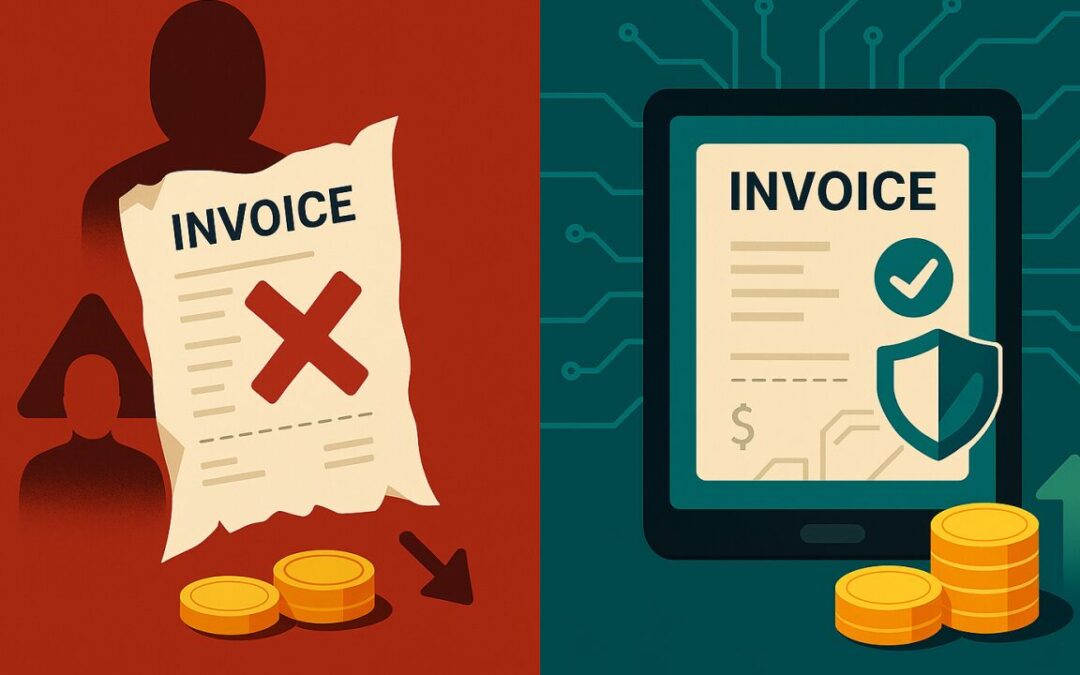
Paper receipts are easy to fake, hard to audit, and painful to reconcile. In a world where 42% of UK organizations have experienced supply chain fraud and 35% have faced procurement fraud in the last 24 months, the need for secure documentation has never been clearer.
In today’s e-commerce and corporate finance landscape, the shift from traditional paper documents to digital receipts and invoices is transforming how businesses and consumers transact. Beyond convenience, digital documentation improves transparency, strengthens auditability, and plays a pivotal role in fraud prevention. Digital receipts and e-invoices flip the script—making every transaction verifiable, traceable, and machine-checkable end-to-end.
Drawing on insights from PwC, McKinsey, Deloitte, and global regulatory frameworks, this article explores how digital receipts and invoices matter for three core groups: Consumers, Finance Teams, and Expense/3rd Party Platforms. It also highlights quantifiable benefits and compliance implications shaping the future of transaction integrity.
For Users (Consumers & Buyers)
QR Code Receipts & Validation
Digital receipts embedded with unique QR codes enable instant authenticity verification through retailer or SaaS provider platforms. For example, Amazon uses QR-enabled receipts to reduce return fraud, allowing customers to confirm purchase validity on the spot. Buyers can validate details (merchant ID, timestamp, tax, line items) against the issuer’s system—no more “Photoshopped” paper slips.
Self-Validation Options
Enabling users to validate receipts by entering receipt numbers or uploading images significantly reduces fake or duplicate claims. This increases confidence during returns, warranty claims, or insurance submissions by ensuring only genuine documents are used.
Tamper-Proof Digital Records
Once generated, digital receipts are securely stored in an immutable form, ensuring they cannot be altered. This is crucial for preserving warranties, managing returns, resolving disputes, and processing insurance claims, where reliable evidence is mandatory.
For Finance Teams (Retailers & Businesses)
Automated Receipt Validation (Single & Bulk)
Finance teams benefit from automation that validates thousands of invoices daily with high accuracy. McKinsey reports that automating invoice processing can cut operational costs by up to 70%, while drastically reducing manual errors. PwC highlights AI agents that connect to policy, process, and invoice data to handle high-volume queries and reconciliations.
AI-Based Fraud Detection
AI models analyze invoice data to detect unusual spending patterns or duplicate claims. Deloitte estimates that enterprises using AI-driven tools cut financial fraud in invoice processing by 30%–50%. For example, AI can automatically flag duplicate receipt numbers. McKinsey also notes that automated workflows reduce fraud losses while improving visibility and cash-forecast accuracy.
Auto-Reconciliation & Error Reduction
Linking digital invoices with POS sales data, inventory movements, and payment records eliminates ghost entries and inflated returns. This integration enhances accuracy and reduces reconciliation time, creating a single source of truth (also emphasized in PwC and Deloitte AP/e-invoicing guidance).
Audit Trail & Compliance
Digital receipts create a clear audit trail, logging who issued the document, when, and where. This traceability supports compliance with regulations such as:
- EU e-Invoicing Directive (2014/55/EU): Standardizes electronic invoicing in public procurement.
- Sarbanes-Oxley Act (SOX), USA: Requires stringent documentation and accountability in corporate records.
Deloitte highlights that e-invoicing/e-reporting is now a global compliance reality, designed to combat fraud and close VAT gaps. Using digital receipts allows companies to demonstrate compliance efficiently and avoid costly penalties.
For Expense Management & 3rd Party Platforms
API Integration for Transparency
Platforms can pull line-item data directly from issuers via APIs or webhooks, preserving provenance and eliminating employee-edited uploads. Deloitte stresses the “beyond-compliance” value of structured, real-time data.
Intelligent Automation Support
Automatically tagging expenses (e.g., travel, meals, utilities) standardizes reporting and reduces opportunities for manipulation. Auto-tagging (by cost center, project, or category), auto-policy checks, and auto-approvals for low-risk claims free up finance teams to focus on exceptions. McKinsey and PwC push such automation to fewer errors and faster cycle times.
AI-Powered Insights & Fraud Alerts
Expense tools equipped with AI can flag suspicious activities, such as identical receipts submitted by multiple employees or invoices tied to blacklisted vendors. These early alerts help organizations act quickly, reducing financial exposure. Governments are even piloting AI-based “violation detectors” to flag risky claims at scale.
The Bigger Picture: Industry Evolution
- Data Privacy & Security: Encrypted storage of digital receipts, compliant with GDPR and other privacy laws, safeguards consumer data—a key factor for building trust and meeting legal obligations.
- Blockchain for Tamper-Proof Records: Some innovators are exploring blockchain to guarantee authenticity and immutability, offering even stronger fraud resistance.
- Industry Announcements: The expansion of the PEPPOL network in Europe is driving cross-border e-invoicing interoperability, setting a model for global alignment.
Why This Matters Now
Adopting digital receipts and invoices delivers a triple advantage:
- Traceable: A reliable audit trail for transparency across stakeholders.
- Tamper-Proof: Minimizes fraud and unauthorized alterations.
- Automatable: Streamlines processes, reduces costs, and accelerates workflows.
As regulations tighten and fraud schemes grow more sophisticated, digital documentation is shifting from a “nice to have” to essential infrastructure. Organizations that act early will be better prepared for future compliance requirements.
The future belongs to businesses that can demonstrate transaction integrity at every step. For finance teams, this means less time on manual verification and more time on strategic analysis. For users, it means confidence that their transactions are secure and verifiable. For the broader ecosystem, it means a more transparent, efficient marketplace.
If you’re curious about how your organization can leverage digital invoices and receipts for better fraud prevention, efficiency, and transparency, feel free to reach out. Sometimes, the right conversation can spark the right transformation. The tools are ready—what matters is how you put them to work.
Sources
- McKinsey:
- Global Payments Report – https://www.mckinsey.com/~/media/mckinsey/industries/financial%20services/our%20insights/the%202021%20mckinsey%20global%20payments%20report/2021-mckinsey-global-payments-report.pdf
- AI in financial crime prevention – https://www.mckinsey.com/capabilities/risk-and-resilience/our-insights/how-agentic-ai-can-change-the-way-banks-fight-financial-crime
- Deloitte:
- E-invoicing/e-reporting – https://www.deloitte.com/us/en/services/tax/articles/e-reporting-e-invoicing-e-volving.html
- OECD:
- Tax Administration 3.0 and E-invoicing – https://www.oecd.org/content/dam/oecd/en/publications/reports/2022/09/tax-administration-3-0-and-electronic-invoicing_59ac73c5/2ffc88ed-en.pdf
- European Commission (ViDA):
- VAT in the Digital Age package – https://taxation-customs.ec.europa.eu/news/adoption-vat-digital-age-package-2025-03-11_en
- PwC:
- E-invoicing and GST benefits – https://www.pwc.in/tax-knowledge-hub/navigate-tax/navigate-e-invoicing/blogs/e-invoicing-a-major-step-towards-digital-tax-administration.html
- AP automation & AI in invoice operations – https://www.pwc.com/gx/en/news-room/assets/analyst-citations/idc-spotlight-transforming-accounts-payable.pdf
- Top e-commerce fraud risks – https://premierconstructionnews.com/2025/07/23/forter-and-pwc-report-reveals-top-5-ecommerce-fraud-risks-in-2025/
- The Times:
- AI “violation detector” in expenses – https://www.thetimes.co.uk/article/ai-violation-detector-will-scan-civil-service-expense-claims-trs0l7stq